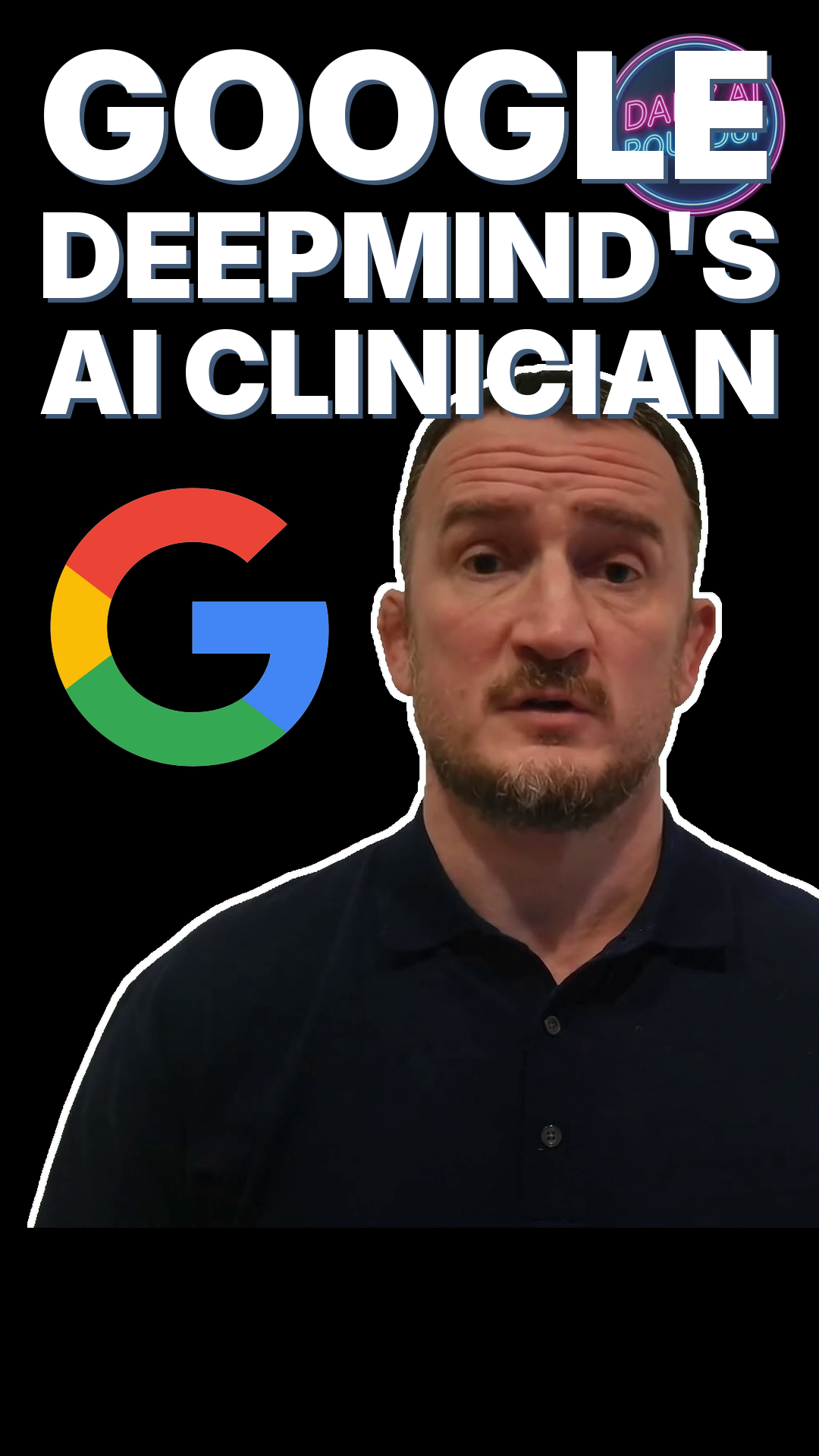
Google DeepMind Launches AI Co-Clinician - Multimodal Agents That Watch, Listen, and Reason
0:00 / 0:59
Sources
News
Google DeepMind Launches AI Co-Clinician - Multimodal Agents That Watch, Listen, and Reason
calendar_today Date:
schedule Duration: 0:59
visibility Views: 238
database
Summary Report
Google DeepMind unveils AI co-clinician, a multimodal research system using live video and audio to support physicians, scoring zero critical errors in 97 of 98 primary care queries.
- 01. AI co-clinician is Google DeepMind's new research initiative for multimodal AI agents that support healthcare workers and patients alongside, not in place of, clinicians.
- 02. The system processes live video and audio in real time to assess physical symptoms - watching a patient's walk, listening to breathing, or examining a rash.
- 03. In adapted NOHARM safety testing it recorded zero critical errors across 97 of 98 primary care queries, outperforming AI tools physicians currently use.
- 04. A 140-area simulation study with Harvard Medical School and Stanford Medicine showed it matched or outperformed physicians in 68 areas, including triage, while humans retained the edge on red flags and physical exams.
- 05. A dual-agent architecture pairs a Talker that runs the conversation with a Planner that monitors for safety drift, with trusted-tester rollout planned across the US, India, Australia, New Zealand, Singapore, and the UAE.
Google DeepMind has unveiled AI Co-Clinician, a research initiative designed to work alongside medical professionals rather than replace them. The system processes live video and audio feeds to analyse physical symptoms in real time, observing patient movement, listening to breathing patterns, and examining visible conditions like rashes.
The system demonstrated impressive safety performance in adapted NOHARM testing, recording zero critical errors across 97 of 98 primary care queries. This performance exceeded current AI tools used by physicians. In a comprehensive 140-area simulation study conducted with Harvard Medical School and Stanford Medicine, the AI matched or outperformed doctors in 68 areas, including patient triage.
Notably, human physicians maintained their advantage in critical areas such as identifying red flags and conducting physical examinations. The system employs a dual-agent architecture featuring a 'Talker' component that manages patient conversations and a 'Planner' component that monitors interactions for potential safety issues.
Google DeepMind plans to deploy the system to trusted testers across six countries for further evaluation. The initiative represents a shift towards collaborative AI in healthcare, positioning artificial intelligence as a supportive tool that provides an additional perspective rather than attempting to replace clinical expertise entirely.