GPT-5.4-Cyber Is Here - OpenAI's Answer to Claude Mythos in the AI Cybersecurity Race
0:00 / 0:00
News
GPT-5.4-Cyber Is Here - OpenAI's Answer to Claude Mythos in the AI Cybersecurity Race
calendar_today Date:
visibility Views: 667
database
Summary Report
OpenAI launches GPT-5.4-Cyber, a cybersecurity-focused model with reduced safety restrictions, directly competing with Anthropic's Mythos in the AI cybersecurity race.
- 01. OpenAI launched GPT-5.4-Cyber with reduced safety restrictions for cybersecurity tasks including vulnerability analysis and reverse engineering
- 02. Access is limited to vetted defenders through the Trusted Access for Cyber programme expanding to thousands of security professionals
- 03. The launch directly follows Anthropic's Mythos completing AISI's cyber range assessment, suggesting competitive pressure
- 04. Both companies are positioning their models as defensive tools despite their dual-use potential
- 05. Bloomberg reports this as a direct race between OpenAI and Anthropic in AI cybersecurity
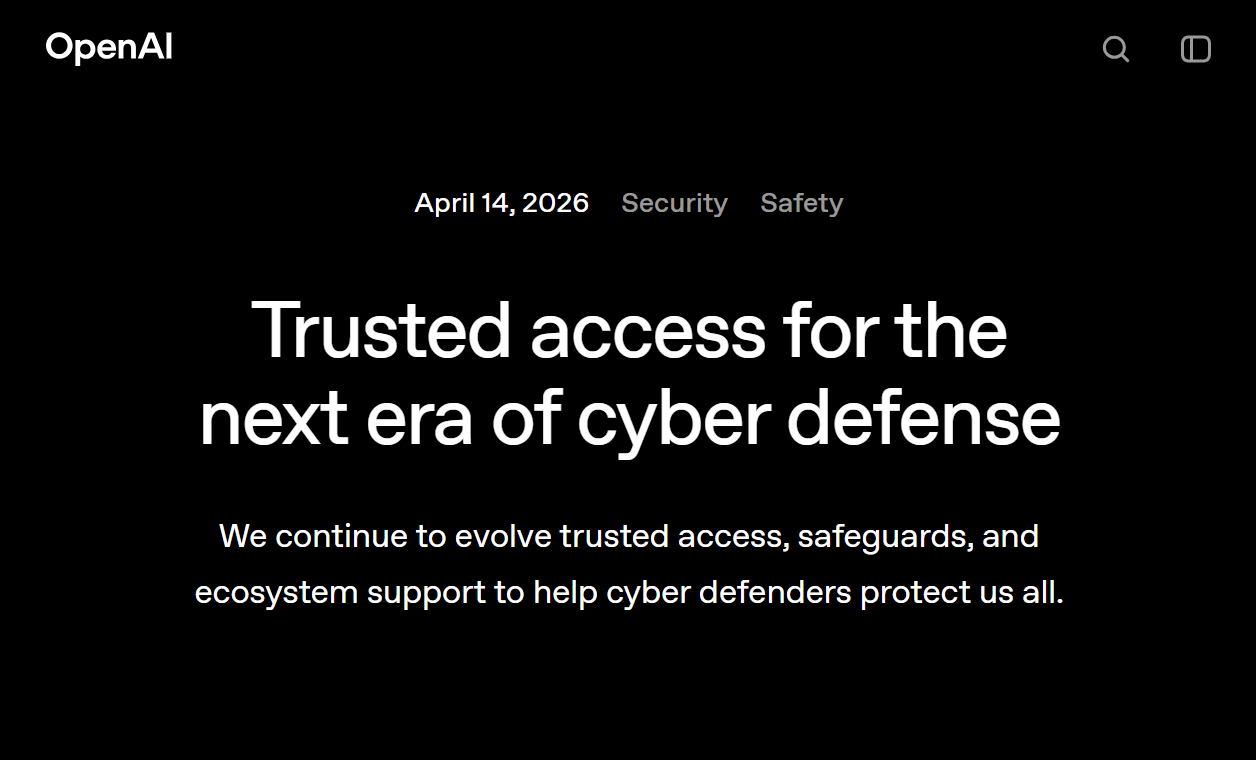
OpenAI has released GPT-5.4-Cyber, a specialised version of its latest language model fine-tuned specifically for cybersecurity applications. The model features significantly reduced safety refusals for legitimate security tasks, enabling capabilities such as advanced vulnerability analysis and binary reverse engineering that the standard GPT-5.4 would typically refuse to perform.
Access to GPT-5.4-Cyber is strictly controlled through OpenAI's Trusted Access for Cyber programme, which is expanding to include thousands of authenticated individual security professionals and hundreds of security teams responsible for protecting critical infrastructure. Only the highest tier of verified defenders can utilise the unrestricted model.
The launch comes just one day after reports confirmed that Anthropic's competing Mythos model successfully completed AISI's comprehensive cyber range assessment end-to-end. This timing suggests a direct competitive response, with Bloomberg already characterising the developments as a race between the two AI giants to dominate the cybersecurity space.
The emergence of these powerful AI tools designed for cybersecurity raises important questions about the dual-use nature of such capabilities. While both companies frame their models as defensive tools, the underlying technologies that enable sophisticated vulnerability analysis and reverse engineering could potentially be misused if proper access controls fail.