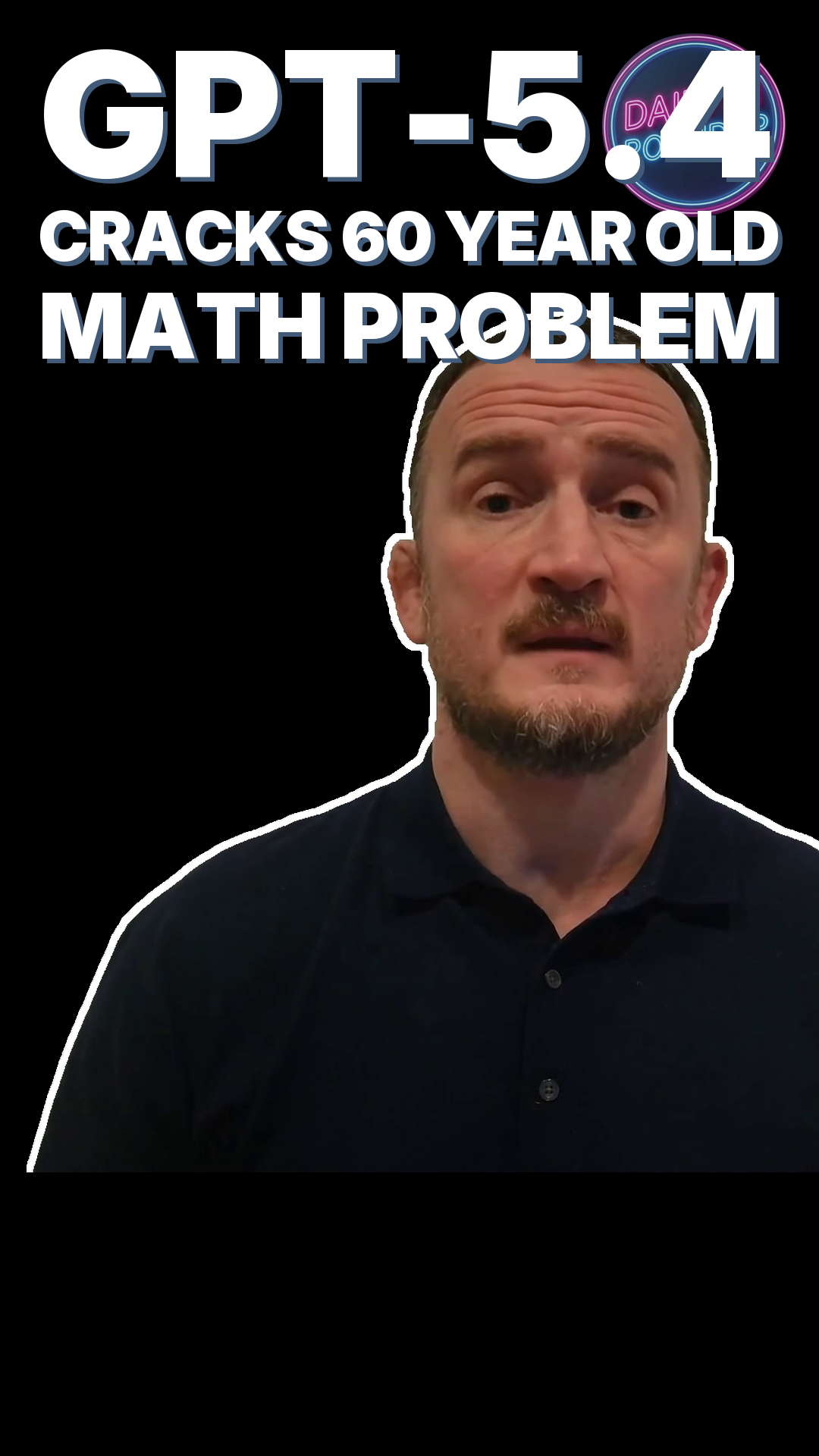
GPT-5.4 Pro Cracks a 60-Year Erdős Problem - 23-Year-Old Amateur, One Prompt, 80 Minutes
0:00 / 0:59
News
GPT-5.4 Pro Cracks a 60-Year Erdős Problem - 23-Year-Old Amateur, One Prompt, 80 Minutes
calendar_today Date:
schedule Duration: 0:59
visibility Views: 3,495
database
Summary Report
A 23-year-old amateur used a single prompt to GPT-5.4 Pro to crack a 60-year-old Erdős problem on primitive sets, applying a 90-year-old technique no expert had thought to try.
- 01. Liam Price, 23, solved a 60-year-old Erdős problem on primitive sets.
- 02. The proof came from a single prompt to GPT-5.4 Pro in about 80 minutes.
- 03. GPT-5.4 Pro combined Markov chains with von Mangoldt weights to reach the result.
- 04. The technique has existed for 90 years but had never been applied to this problem.
- 05. The proof was published on erdosproblems.com.
Liam Price, a 23-year-old with no advanced mathematical training, has solved a problem that has challenged professional mathematicians for six decades. Using ChatGPT 5.4 Pro with just one prompt, Price cracked an Erdős conjecture about primitive sets in roughly 80 minutes, publishing his proof on erdosproblems.com last week.
The problem, posed by legendary mathematician Paul Erdős, concerns primitive sets—collections of whole numbers where no member divides another. Erdős conjectured that the sum for these sets approached one as the numbers grew large. GPT-5.4 Pro solved it by combining Markov chains with von Mangoldt weights, mathematical techniques that have existed for 90 years but had never been applied to this specific problem.
What has particularly struck professional mathematicians is that the AI didn't invent new mathematics. Instead, it identified an existing mathematical tool that no human researcher had thought to apply to this problem. This represents a fundamental shift in how mathematical research might be conducted, where AI systems can spot connections between established techniques and unsolved problems that human experts have overlooked.
The breakthrough highlights AI's potential to accelerate mathematical discovery not through creating novel methods, but by recognising unexpected applications of existing knowledge across vast mathematical literature that would be impossible for any individual researcher to fully comprehend.