MIRA Renders a Live Multiplayer Rocket League Match With No Physics Engine
0:00 / 0:38
News
MIRA Renders a Live Multiplayer Rocket League Match With No Physics Engine
calendar_today Date:
schedule Duration: 0:38
visibility Views: 111
database
Summary Report
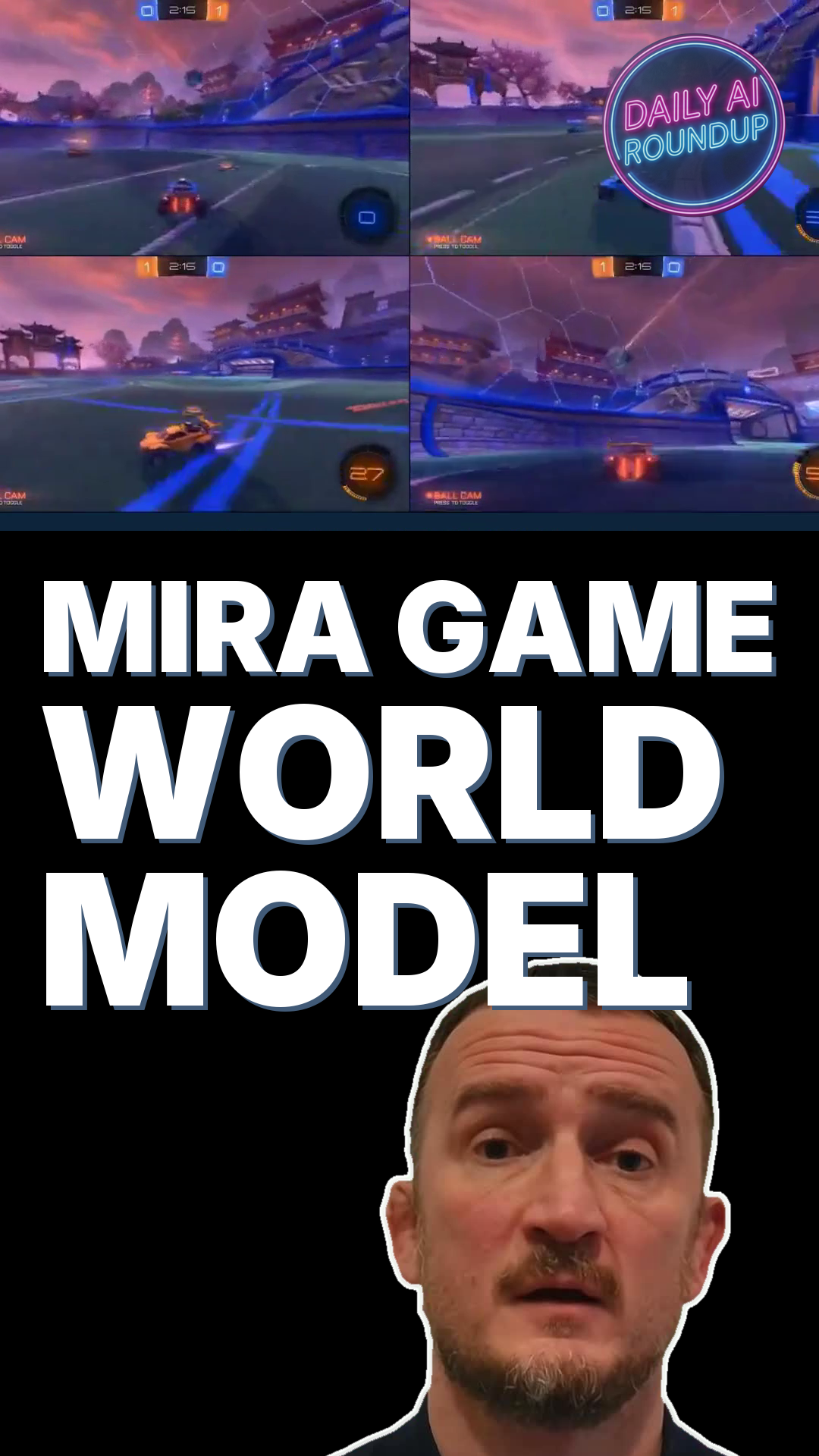
General Intuition and Kyutai's MIRA renders a live, four-player Rocket League match with no physics engine at all, trained purely on bot gameplay.
- 01. General Intuition and Kyutai built MIRA, a world model that plays live four-player Rocket League at 20fps.
- 02. It has no physics engine and no graphics code - the model renders the game purely from learned dynamics.
- 03. Trained on ten thousand hours of bots playing each other, with zero human gameplay data.
- 04. The code, training data and a playable demo are all open.
MIRA is a world model built by General Intuition and Kyutai that generates a full four-player Rocket League match in real time, running at twenty frames per second, without any traditional physics engine or graphics rendering code behind it. Instead, the entire match is predicted frame by frame by a neural network that has learned the rules and behaviour of the game purely from watching it played.
The model was trained on ten thousand hours of footage from bots playing Rocket League against each other. From this data alone, MIRA has learned to keep track of the ball's trajectory, each player's boost meter, and the state of all four screens simultaneously, maintaining consistency across the match for minutes at a time. This is a notably harder problem than generating a single-player scene, since the model has to keep multiple independent viewpoints and shared game state in sync without any explicit rules telling it how physics or scoring work.
World models of this kind differ fundamentally from conventional game engines. A standard game runs on hand-coded physics, collision detection and rendering pipelines built by engineers. MIRA instead predicts what the next frame should look like based on patterns learned from prior gameplay, effectively simulating the game rather than computing it. That the model can hold a coherent four-player match together, with plausible ball physics and boost mechanics, for several minutes suggests these systems are becoming capable of far more than short, single-agent demos.
General Intuition and Kyutai have released the code, the training data and a playable demo, allowing anyone to try MIRA or build on it directly. Open access of this kind is notable given how compute-intensive training such models typically is, and it gives researchers a concrete benchmark for how far real-time, learned simulation of multiplayer environments has progressed.